University Chemistry ›› 2024, Vol. 39 ›› Issue (1): 142-147.doi: 10.3866/PKU.DXHX202306056

• Chemistry Laboratory • Previous Articles     Next Articles

Determination of Zinc Content in Zinc Gluconate Oral Solution by Flame Atomic Absorption Spectrometry

Jinfan Xu1, Xinyu Zhu1, Ke Yang1, Erwen Yang1, Zhihan Zhao1, Qiutong Chen1, Hongyi Li1, Jinkai Cheng1, Yijun Sun1, Jing Wang1,3, Langxing Chen1,2, Anna Tang1,2,*()   

  1. 1 College of Chemistry, Nankai University, Tianjin 300071, China
    2 Tianjin Key Laboratory of Biosensing and Molecular Recognition, Research Center for Analytical Sciences, Nankai University, Tianjin 300071, China
    3 National Demonstration Center for Experimental Chemistry Education, Nankai University, Tianjin 300071, China
  • Received:2023-06-27 Accepted:2023-07-11 Published:2023-07-19
  • Contact: Anna Tang E-mail:tanganna@nankai.com

Abstract:

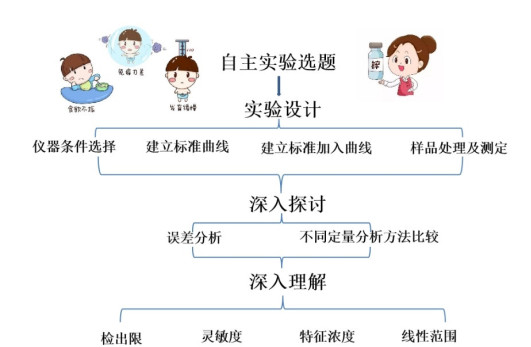
Flame atomic absorption spectrometry (FAAS) is an important experiment in instrumental analysis laboratory teaching for undergraduates. Atomic absorption spectroscopy (AAS) is used to quantitatively determine a specific element in real samples, which has the advantages of high accuracy, precision, and selectivity. Zinc gluconate oral solution is a common over-the-counter zinc supplement in daily life. Through independent experiments of undergraduates, a simple and easy-to-operate FAAS method is established to determine the zinc content in zinc gluconate oral solution. This experiment aims to cultivate students' ability to apply theoretical knowledge learned in class to solve practical problems, and achieve the educational goal of "learning for application, and application to promote learning".

Key words: Independent experiment, Atomic absorption spectrometry, Zinc content