大学化学 >> 2024, Vol. 39 >> Issue (1): 305-308.doi: 10.3866/PKU.DXHX202305080

师生笔谈 上一篇    下一篇

NaHCO3溶液浓度改变引起的支配质子转移反应变化:从HCO3−质子自递反应到HCO3−水解反应

柳青1, 刘建宇2,*(), 王海水2,*()   

  1. 1 华南理工大学分析测试中心, 广州 510640
    2School of Chemistry and Chemical Engineering, South China University of Technology, Guangzhou 510640, China
  • 收稿日期:2023-05-29 录用日期:2023-07-11 发布日期:2023-07-19
  • 通讯作者: 刘建宇,王海水 E-mail:jyliu@scut.edu.cn;wanghsh@scut.edu.cn
  • 基金资助:
    国家自然科学基金(21773072);华南理工大学教研教改项目(C9233073)

Shift of the Dominant Proton Transfer Reaction from Autoprotolysis of HCO3− to Hydrolysis of HCO3− Caused by Concentration Change of the NaHCO3 Solution

Qing Liu1, Jianyu Liu2,*(), Haishui Wang2,*()   

  1. 1 Analytical and Testing Center, South China University of Technology, Guangzhou 510640, China
  • Received:2023-05-29 Accepted:2023-07-11 Published:2023-07-19
  • Contact: Jianyu Liu, Haishui Wang E-mail:jyliu@scut.edu.cn;wanghsh@scut.edu.cn

摘要:

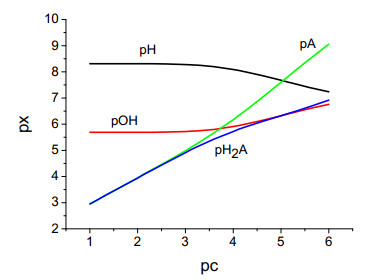
NaHCO3水溶液中存在多个质子转移反应和多重化学平衡。随溶液浓度改变,各质子反应所占的相对比重将发生变化,与质子转移相关的产物H2CO3、H+、OH−和CO32−的相对含量也会发生变化。绘制了[H2CO3]、[H+]、[OH−]和[CO32−]随溶液浓度c变化的动态图。从动态图上,可以直观地观察到哪些酸碱组分是主要组分,哪些组分是次要组分。较浓溶液中,[H2CO3] ≈ [CO32−] > > [OH−] > > [H+],表明能够产生H+或OH−的质子反应占据次要地位,质子反应HCO3− + HCO3−$ \text{}\text{⇌} $ H2CO3 + CO32−占据支配地位。9.1 × 10⁻⁶ mol∙L−1溶液中,[OH−] ≈ [H2CO3] > > [H+] ≈ [CO32−],表明质子反应H2O + HCO3− $ \rightleftharpoons $ H2CO3 + OH−占据支配地位。极稀溶液中,[OH−] ≈ [H+] > > [H2CO3] > [CO32−],表明H2O$ \rightleftharpoons $ H+ + OH−占据支配地位。溶液的酸碱性质主要由起支配作用的质子转移反应控制。

关键词: 碳酸氢钠溶液, 多重平衡, 支配反应, 反应产物含量图

Abstract:

There are several proton transfer reactions and multiple chemical equilibria in NaHCO3 aqueous solution. As the concentration of the solution changes, the contents of H2CO3, H+, OH− and CO32−, which are related to proton transfer reactions, also change. The diagram of [H2CO3], [H+], [OH−] and [CO32−] with solution concentration c is plotted. From the diagram, we can directly observe which species are the major and which are the minor. In a high concentration, [H2CO3] ≈ [CO32−] > > [OH−] > > [H+], indicating that the proton reactions which can produce H+ or OH− are negligible, and HCO3− + HCO3−$ \rightleftharpoons $ H2CO3 + CO32− is the dominant. In 9.1 × 10⁻⁶ mol∙L−1 solution, [OH−] ≈ [H2CO3] > > [H+] ≈ [CO32−], indicating that H2O + HCO3− $ \rightleftharpoons $ H2CO3 + OH− is the dominant. In an extremely dilute solution, [OH−] ≈ [H+] > > [H2CO3] > [CO32−], indicating that H2O$ \rightleftharpoons $ H+ + OH− dominates.

Key words: NaHCO3 solution, Multiple chemical equilibria, Dominant reaction, Diagram for the contents of the reaction products