大学化学 >> 2023, Vol. 38 >> Issue (2): 109-115.doi: 10.3866/PKU.DXHX202204052

知识介绍 上一篇    下一篇

溴与不同取代C=C双键反应的机理和立体选择性

许家喜1,*, 麻远2   

  1. 1 北京化工大学化学学院, 北京 100029
    2 清华大学化学系, 北京 100084
  • 收稿日期:2022-04-14 录用日期:2022-06-16 发布日期:2022-07-01
  • 通讯作者: 许家喜
  • 基金资助:
    《有机化学》和《中级有机化学》一流课程建设项目

Mechanisms and Stereoselectivities in the Reactions of Bromine and Different Substituted C=C Bonds

Jiaxi Xu1,*, Yuan Ma2   

  1. 1 College of Chemistry, Beijing University of Chemical Technology, Beijing 100029, China
    2 Department of Chemistry, Tsinghua University, Beijing 100084, China
  • Received:2022-04-14 Accepted:2022-06-16 Published:2022-07-01
  • Contact: Jiaxi Xu

摘要:

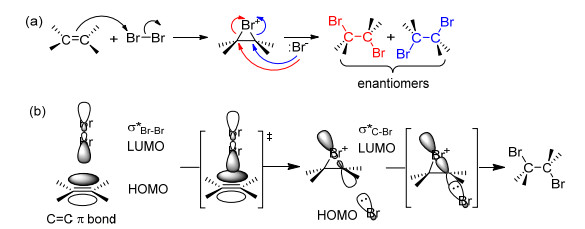
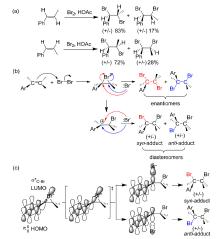
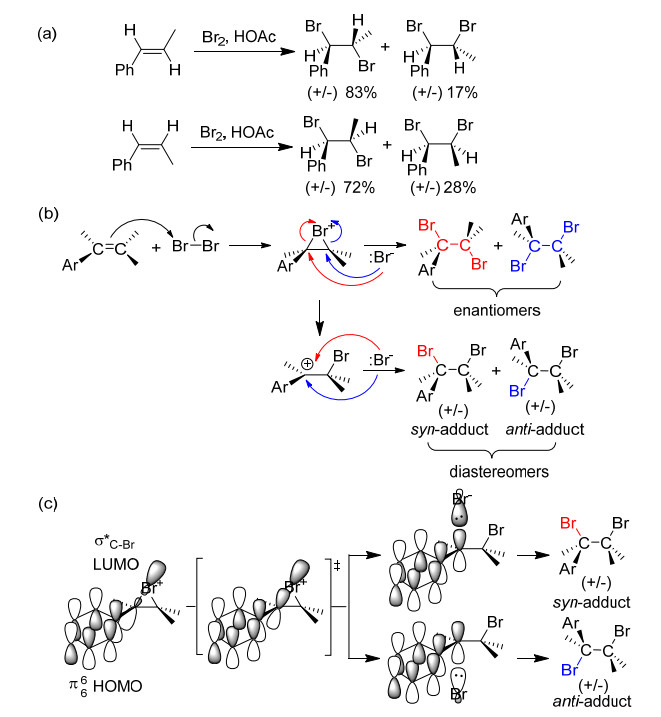
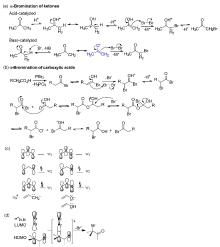
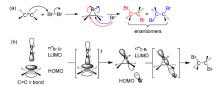
溴与C=C双键的反应是有机化学中一类常见的基元反应。溴与烯烃的C=C双键发生亲电加成反应,脂肪烯烃经过三元环正离子中间体再亲核开环机理,形成立体专一的反式加成产物;而芳基烯烃形成的三元环中间体,由于芳基对碳正离子的稳定作用,其苯甲位C―Br键容易断裂,会得到顺式和反式加成产物的混合物。溴与酮和酰氯形成的烯醇或烯醇负离子发生亲电取代,反应中溴不会与其C=C双键形成三元环正离子中间体。类似地,溴与烯醇醚和烯胺的反应也不经过三元环正离子中间体,分别生成非立体专一的加成和取代产物。本文通过参与该步基元反应的分子轨道合理地解释了溴与这两类底物反应的机理和立体选择性的区别,并总结了溴与不同C=C双键反应机理的判断方法,便于教师讲授和学生理解。

关键词: 反应, 溴, C=C键, 机理, 分子轨道

Abstract:

Reaction of bromine and the C=C double bond is one of common elementary reactions in organic chemistry. Bromine and alkenes undergo an electrophilic addition. Aliphatic alkenes undergo formation of three-membered cyclic bromonium intermediates and subsequent ring-opening mechanism, affording stereospecific trans-dibromoadducts, while the three-membered cyclic bromonium intermediates of arylolefins favor to dissociate their benzylic C―Br bond due to aryl stabilizing the generated carbocations, producing a mixture of cis- and trans-dibromoadducts. However, bromine and enols or enolates generated from ketones or carboxylic halides undergo electrophilic substitutions. Bromine does not generate the corresponding three-membered cyclic bromonium intermediates with their C=C bond in the reactions. Similarly, the reactions of viny ethers and enamines with bromine do not undergo the three-membered cyclic bromonium intermediates, either, generating nonstereospecific adducts and substituted products, respectively. This article rationally explains the mechanistic and stereoselective differentiations between the reactions of bromine and these two classes of reactants with reactive molecular orbitals in the elementary reaction, and summarizes the identification method on the reaction mechanism and stereoselectivity of the reactions between bromine and different C=C bonds, hoping to be convenient for teaching and understanding.

Key words: Reaction, Bromine, C=C bond, Mechanism, Molecular orbital