
ISSN: 1000-8438
CN: 11-1818/O6
CN: 11-1818/O6


大学化学 >> 2023, Vol. 38 >> Issue (11): 206-215.doi: 10.3866/PKU.DXHX202304055
蒋海英( ), 穆玥如, 张媛媛, 孙雪, 王云侠, 郭慧林, 岳可芬
收稿日期:2023-04-18
录用日期:2023-06-08
发布日期:2023-06-12
通讯作者:
蒋海英
E-mail:jianghy@nwu.edu.cn
基金资助:
Hai-Ying Jiang(), Yueru Mu, Yuanyuan Zhang, Xue Sun, Yunxia Wang, Huilin Guo, Kefen Yue
Received:2023-04-18
Accepted:2023-06-08
Published:2023-06-12
Contact:
Hai-Ying Jiang
E-mail:jianghy@nwu.edu.cn
摘要:
为了培养本科生综合运用所学知识分析和解决问题的能力,本文基于最新研究成果,深入挖掘其中所涉及的本科基础化学知识,设计了探究苯乙炔铜(Ph-C≡C-Cu)基新型功能材料结构-性质-效能关系的综合实验。本实验通过光热合成法制备了三种含不同官能团的Ph-C≡C-Cu基新型功能材料,利用红外(FT-IR)光谱、紫外-可见吸收(UV-Vis Abs)光谱和稳态水接触角表征了其结构和相关物理化学性质,并研究了其结构对于有机染料甲基橙(MO)的吸附和降解效能的影响。作为本科生基础教学实验,本实验考查了学生对有机化学中不同官能团的电子效应和物理化学中液-固界面相互作用、固体在溶液中的吸附、催化反应动力学以及反应级数的判定等知识的理解、掌握和应用。通过进一步总结与讨论Ph-C≡C-Cu基新型功能材料的结构-性质-效能关系,启发并引导学生以实际问题为导向,根据所学理论和知识,从源头上出发,对功能材料的结构进行设计,培养了本科生的逆向思维方式,提升了本科生理论与实践相结合的能力。
蒋海英, 穆玥如, 张媛媛, 孙雪, 王云侠, 郭慧林, 岳可芬. Ph-C≡C-Cu基新型功能材料的结构-性质-效能关系探究[J]. 大学化学, 2023, 38(11): 206-215.
Hai-Ying Jiang, Yueru Mu, Yuanyuan Zhang, Xue Sun, Yunxia Wang, Huilin Guo, Kefen Yue. Structure-Property-Effect Relationship of New Copper Phenylacetylene-Based Functional Materials[J]. University Chemistry, 2023, 38(11): 206-215.
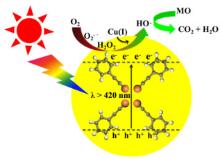
图1
Ph-C≡C-Cu光催化降解MO的示意图[10]"
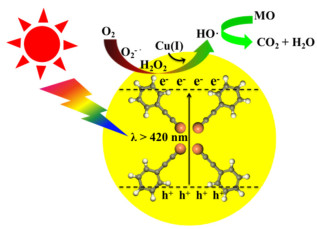
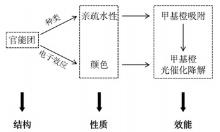
图2
Ph-C≡C-Cu基材料的结构-性质-效能关系总结"


表1
主要实验试剂"
| 试剂名称 | 纯度/质量分数 | 生产工厂 |
| Ph-C≡C-H | 98% + | 上海阿达玛斯试剂 |
| 4-F-Ph-C≡C-H | 98% + | 同上 |
| 3-OH-Ph-C≡C-H | 98% + | 同上 |
| MO | 分析纯 | 天津市天新精细化工开发中心 |
| NaOH | 96% | 天津市天力化学试剂有限公司 |
| CuCl | 97% | 阿拉丁 |
| KBr | 光谱纯 | 天津市科密欧化学试剂有限公司 |
| CH3OH | 分析纯 | 天津市富宇精细化工有限公司 |
表2
主要实验仪器"
| 仪器名称 | 型号 | 制造商 |
| 氙灯 | PLS-SXE300D | 北京泊菲莱 |
| 红外光谱 | TENSOR 27 | 德国布鲁克 |
| 接触角测试仪 | DSA25 | 德国Kruss |
| 紫外-可见光谱仪 | UV-3600 plus | 日本Shimadzu |
表3
不同的苯乙炔原料所需的体积"
| Ph-C≡C-Cu基光催化剂 | 原料 | 体积/μL |
| 3-OH-Ph-C≡C-Cu | 3-OH-Ph-C≡C-H | 400 |
| Ph-C≡C-Cu | Ph-C≡C-H | 440 |
| 4-F-Ph-C≡C-Cu | 4-F-Ph-C≡C-H | 458 |
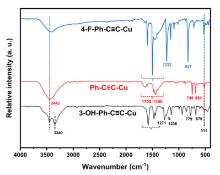
图3
Ph-C≡C-Cu基材料的红外光谱"
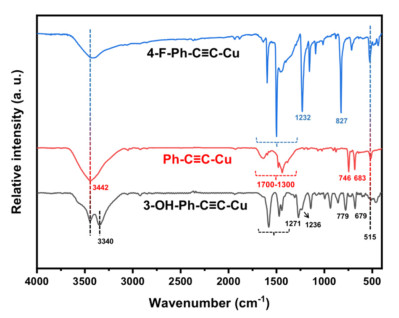
图4
Ph-C≡C-Cu基材料的紫外-可见吸收光谱和制备的粉末样品"
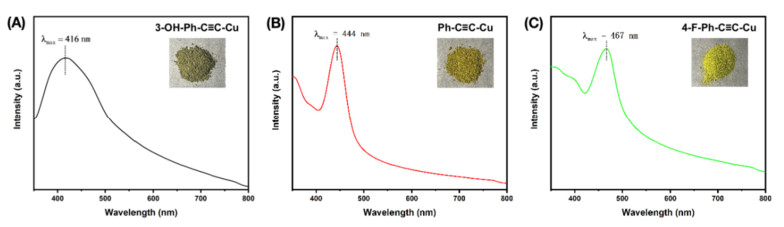
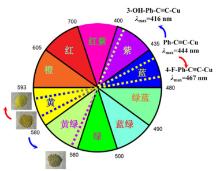
图5
Ph-C≡C-Cu基材料的本体颜色及互补可见颜色 电子版为彩图"
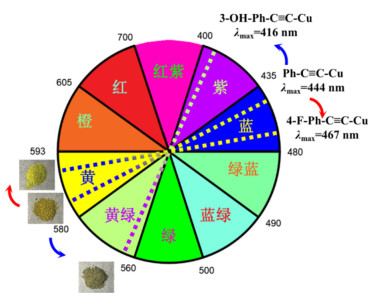
图6
Ph-C≡C-Cu基材料的稳定水接触角"
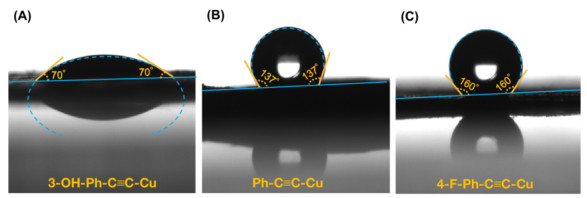
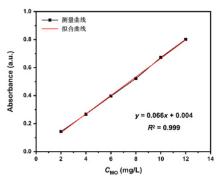
图7
MO在463 nm处的吸收值–浓度的标准曲线"
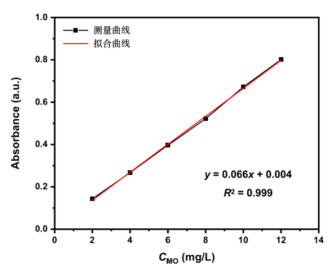
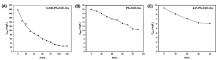
图8
不同Ph-C≡C-Cu基材料吸附MO实验:MO的浓度–时间曲线"
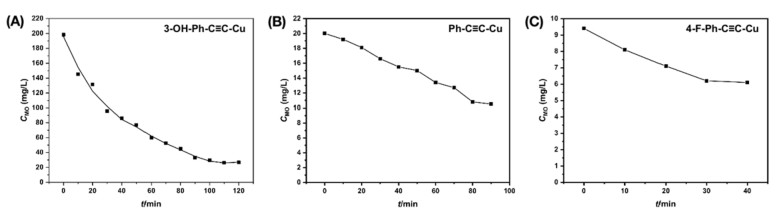
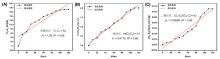
图9
3-OH-Ph-C≡C-Cu吸附MO的动力学过程:不同反应级数的拟合曲线"
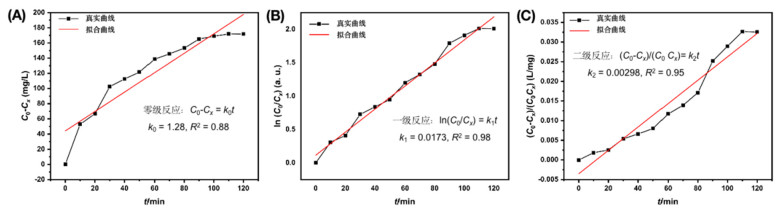
图10
不同Ph-C≡C-Cu基材料光催化降解MO实验:MO的浓度–时间曲线"
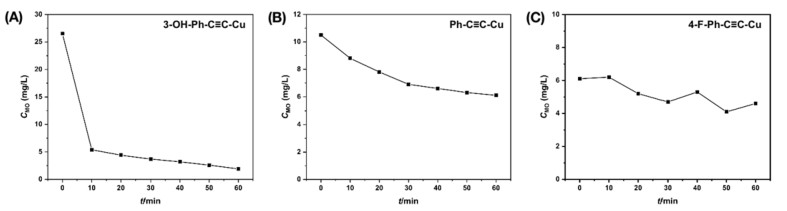
图11
3-OH-Ph-C≡C-Cu光催化降解MO的动力学过程:不同反应级数的拟合曲线"
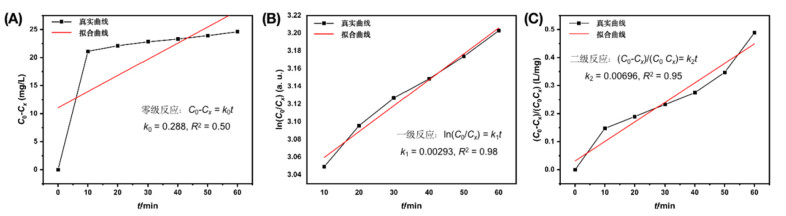
表4
教学时间建议"
| 时间 | 实验项目安排 |
| 第一天上午08:30–10:30 | 制备三种苯乙炔铜基材料 |
| 第一天下午14:30–17:00 | 测定样品的红外光谱及紫外-可见吸收光谱 |
| 第二天上午08:30–11:00 | 测定样品的亲疏水性并绘制MO的标准曲线 |
| 第二天下午14:30–17:30 | 三种材料对MO的吸附、降解实验 |
| 1 | 赵德刚; 王琦. 教育教学论坛, 2018, 10 (13), 205. |
| 2 | 李珺; 张逢星. 高等理科教育, 2003, 11 (1), 50. |
| 3 | 李静萍; 王九思; 许力; 郝艳玲; 李丛芬. 天水师范学院学报, 2006, 26 (2), 79. |
| 4 | 程爱玲; 耿平; 王清江; 陈启明. 实验室研究与探索, 2010, 29 (11), 308. |
| 5 |
Sagadevan A. ; Ragupathi A. ; Lin C.-C. ; Hwu J. R. ; Hwang K. C. Green Chem. 2015, 17, 1113.
doi: 10.1039/C4GC01623H |
| 6 |
Beniazza R. ; Lambert R. ; Harmand L. ; Molton F. ; Duboc C. ; Denisov S. ; Jonusauskas G. ; McClenaghan N. D. ; Lastécouères D. ; Vincent J.-M. Chem. Eur. J. 2014, 20 (41), 13181.
doi: 10.1002/chem.201404056 |
| 7 |
Oishi T. ; Yamaguchi K. ; Mizuno N. ACS Catal. 2011, 1, 1351.
doi: 10.1021/cs200388v |
| 8 |
Feng N. ; Gao C. ; Guo C.-Y. ; Chen G. ACS Appl. Mater. Interfaces 2018, 10, 5603.
doi: 10.1021/acsami.7b19167 |
| 9 |
Liang Q. ; Chang X. ; Su Y. ; Mugo S. M. ; Zhang Q. Angew. Chem. Int. Ed. 2021, 60, 18014.
doi: 10.1002/anie.202100953 |
| 10 | Jiang H.-Y. ; Zhou P. ; Wang Y. ; Duan R. ; Chen C. ; Song W. ; Zhao J. Adv. Mater. 2016, 28 (41), 9776. |
| 11 |
Qian J. ; Dang W. ; Li J. ; Zhang W. ; Tian M. ; Wang N. ; Song W. ; Lv L. ; Jiang H-Y. Catal. Sci. Technol. 2021, 11, 2379.
doi: 10.1039/D0CY02355H |
| 12 | 常建华; 董绮功. 波谱原理及解析, 第3版 北京: 科学出版社, 2012, 53 |
| 13 |
Garbusova I. A. ; Alexanjan V. T. ; Leites L. A. ; Golding I. R. ; Sladkov A. M. J. Organometal. Chem. 1973, 54, 341.
doi: 10.1016/S0022-328X(00)85026-3 |
| 14 | 孙秀香. 物理教师, 1994, 15 (12), 21. |
| 15 | 傅献彩; 沈文霞. 物理化学, 第5版 北京: 高等教育出版社, 2006, 163- 165. |
| [1] | 陈建托, 尚凡朋. 第38届中国化学奥林匹克(初赛)第1题解析与溯源[J]. 大学化学, 2025, 40(10): 303 -308 . |
| [2] | 牛庆涛, 徐新尧, 于伟悦, 孟舒翔, 吕志果, 靳满满. 科教融合在化工专业化工热力学教学中的探索与实践——以化工物性数据估算和化学反应平衡为例[J]. 大学化学, 2025, 40(10): 1 -9 . |
| [3] | 刘雨同, 景学敏. “双碳”目标背景下甲烷的催化转化[J]. 大学化学, 2025, 40(10): 101 -113 . |
| [4] | 黄竹胜, 薛伟, 常永正, 汪联辉, 罗志敏. 物理化学实验教学改革:培养学生创新与实践能力[J]. 大学化学, 2025, 40(10): 10 -16 . |
| [5] | 王琳琳, 刘刚, 柴春笑, 路庆明, 马莹. 6S理念在高校仪器分析化学教学实验室规范化管理中的应用[J]. 大学化学, 2025, 40(10): 186 -193 . |
| [6] | 肖岩松, 黄熠, 马星星, 宋秋玲. Matteson反应在有机合成中的应用:基础到前沿[J]. 大学化学, 2025, 40(10): 114 -120 . |
| [7] | 吴倩, 吕远霞, 郭紫旋, 赵治皓, 张志敏, 卢红梅. 研究型仪器分析综合实验课程的案例与实践[J]. 大学化学, 2025, 40(10): 194 -202 . |
| [8] | 张渝阳, 张雨晴, 毛全兴, 陈梓萱, 熊英. 真实问题为导向的教学方法在分析化学教学中的应用[J]. 大学化学, 2025, 40(10): 17 -22 . |
| [9] | 陈烨荣, 杨冰彬, 何星磊, 林雨琦, 叶克印. 酶定向进化实现有机硅化合物转化[J]. 大学化学, 2025, 40(10): 121 -129 . |
| [10] | 朱佩佩, 汪莉, 陈莉莉, 廖勋凡, 陈义旺. 基于知识图谱的分析化学智慧教学探索[J]. 大学化学, 2025, 40(10): 23 -32 . |
| [11] | 张文文, 张培超, 盖聪昊, 柴晓云, 邹燕, 赵庆杰. 在自然丰度下的动力学揭秘:13C NMR同位素效应实验[J]. 大学化学, 2025, 40(10): 203 -207 . |
| [12] | 于鸿达, 章翰堂, 陈长宝, 尹延斌, 张坤, 尚鹏鹏, 朱树华, 张丽丽. 教育信息化改革下农林院校基础化学实验课程思政建设探索[J]. 大学化学, 2025, 40(10): 33 -38 . |
| [13] | 王一诺, 刘子羽, 谭红霞, 童军, 徐大振. 溴代苯并噁嗪的合成——推荐一个由本科科研创新转化的综合有机化学实验[J]. 大学化学, 2025, 40(10): 208 -216 . |
| [14] | 庄淑婷, 赵丽达. 以学定教,融教于研——微塑料废弃物制备碳量子点的综合实验设计[J]. 大学化学, 2025, 40(10): 217 -224 . |
| [15] | 林峰, 靳忠欣, 李彩莹, 邵秤, 徐扬, 李芳泽, 刘思琦, 顾睿宁. 泡沫镍负载Ni (OH)2-NiMoO4电极材料的制备及其电化学性能[J]. 大学化学, 2025, 40(10): 225 -232 . |
|
||
