University Chemistry ›› 2024, Vol. 39 ›› Issue (3): 199-204.doi: 10.3866/PKU.DXHX202309064

• Study and Reform of Chemical Education • Previous Articles     Next Articles

Application of "Integration of Industry and Education" in Engineering Chemistry: Improvement of the Pesticide Fipronil Production

Shahua Huang1, Xiaoming Guo1, Lin Lin1, Guangping Chang2, Sheng Han1, Zuxin Zhou1,*()   

  1. 1 School of Engineering of Chemical and Environment, Shanghai Institute of Technology, Shanghai 200233, China
    2 Shanghai Pharmaceutical School, Shanghai 200135, China
  • Received:2023-09-18 Accepted:2023-11-08 Published:2023-11-29
  • Contact: Zuxin Zhou E-mail:zhouzuxin@sit.edu.cn

Abstract:

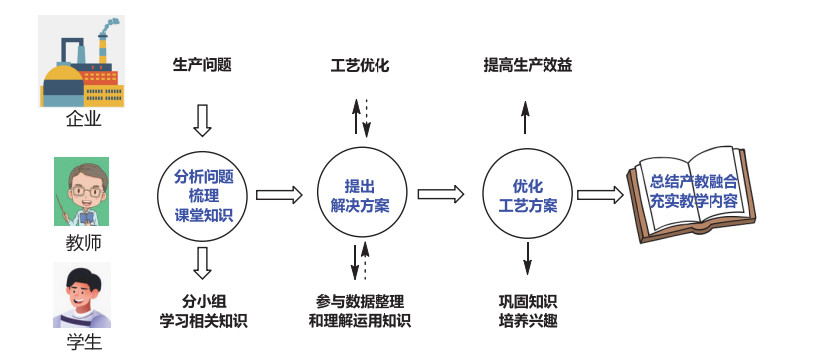
With continuously reforming the current educational system, the application-oriented universities have been evolving the developing mode of the integration of industry and education. Aiming to develop the students' ability of solving problems, the infrastructure of chemistry-related courses is thus reoriented and reformatted. Classroom teaching focuses on the understanding and interpreting knowledge, while companies are aiming to reduce the production cost and improve the output for sufficient profit. The lack of communication between the two can lead students having difficulty to apply the classroom knowledge. In the teaching practice of engineering chemistry course, we combined the production of pesticide Fipronil with classroom teaching as a research topic for teaching and learning. By optimizing the chemical reaction process, we improved the production efficiency. These practices not only enrich the content of teaching topics in the classroom, but also deepen students to better understand the basic principles. Furthermore, the application of the integration practice of industrial application and classroom teaching helps students to develop their own interests in the knowledge-based problem-solving process.

Key words: Industry-education integration, Engineering chemistry, Chemical process, Fipronil