
ISSN: 1000-8438
CN: 11-1818/O6
CN: 11-1818/O6


University Chemistry ›› 2023, Vol. 38 ›› Issue (8): 216-224.doi: 10.3866/PKU.DXHX202210029
• Chemistry Laboratory • Previous Articles Next Articles
Yu Liu1, Jiming Zheng1, Nayan Zongchen1, Hong Wu1,2,*( ), Wanqun Hu1,2,*()
Received:2022-10-10
Accepted:2022-11-11
Published:2023-01-03
Contact:
Hong Wu, Wanqun Hu
E-mail:wuhong90@ustc.edu.cn;hwq@ustc.edu.cn
Yu Liu, Jiming Zheng, Nayan Zongchen, Hong Wu, Wanqun Hu. Combining Infrared Spectroscopy Experiment with Quantum Chemical Calculations to Study Hydrogen Bond in Several Aliphatic Alcohol and CCl4 Solutions[J].University Chemistry, 2023, 38(8): 216-224.
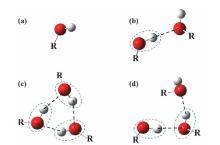
"
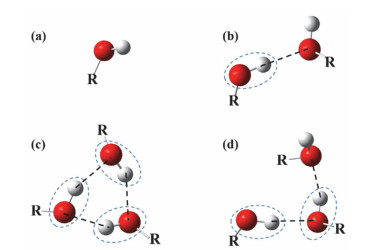

"
| 输入文件 | 含义 |
| %chk=Ethanol_1.chk | 指定checkpoint文件名称 |
| # opt freq b3lyp/6-31+g(d, p) scrf=(iefpcm, solvent=ccl4) geom=connectivity empiricaldispersion=gd3 | 指定计算方法,基组,溶剂,色散矫正 |
| Ethanol | 标题行 |
| 0 1 | 电荷与多重度 |
| C −2.11475407 −1.13661207 0.00000000 | 分子说明部分,确定分子中各原子的坐标(此处为笛卡尔坐标) |
| H −1.75809964 −2.14542207 0.00000000 | |
| C −1.60141185 −0.41065579 1.25740497 | |
| H −0.53141366 −0.41236286 1.25838332 | |
| H −1.95646841 0.59871722 1.25642758 | |
| H −1.95968081 −0.91392379 2.13105517 | |
| H −3.18475407 −1.13659888 0.00000000 | |
| O −1.63807915 −0.46250981 −1.16759033 | |
| H −1.95641249 −0.91575292 −1.95170420 |
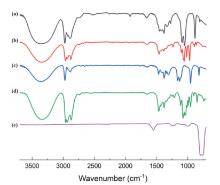
"
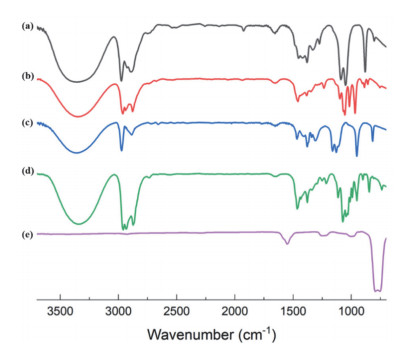
"
| 吸收峰位置/cm−1 | 官能团 |
| ~3362.24 | 缔合羟基(O―H)的伸缩振动吸收峰 |
| 2969.90、2887.82 | 甲基(―CH3)和亚甲基(―CH2)的碳氢伸缩振动吸收峰 |
| 1452.25 | ―CH2碳氢弯曲振动吸收 |
| 1375.10 | ―CH3碳氢弯曲振动吸收 |
| 1088.64、1047.61 | C―O伸缩振动吸收峰 |
| 790.02、758.23 | C―Cl伸缩振动吸收峰 |
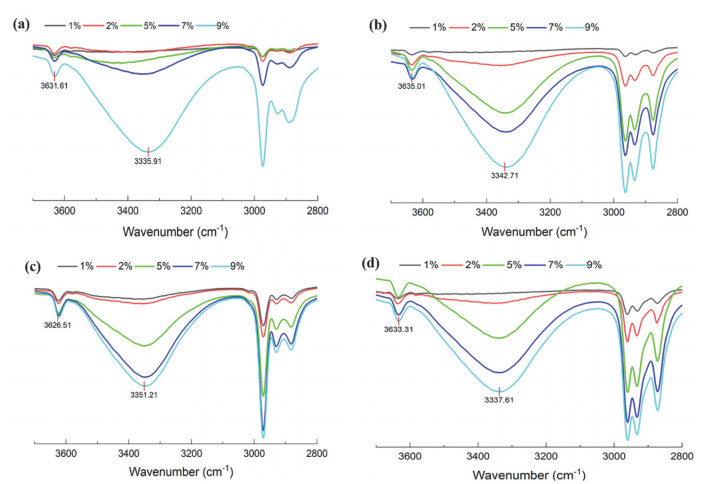
"
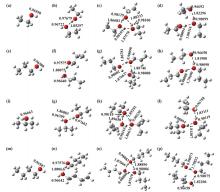
"

"
| 脂肪醇 | 单体 | 二聚体 | 环状三聚体 | 链状三聚体 | |||||
| νOH | νBonded OH | νFree OH | νBonded OH | νBonded OH | νFree OH | ||||
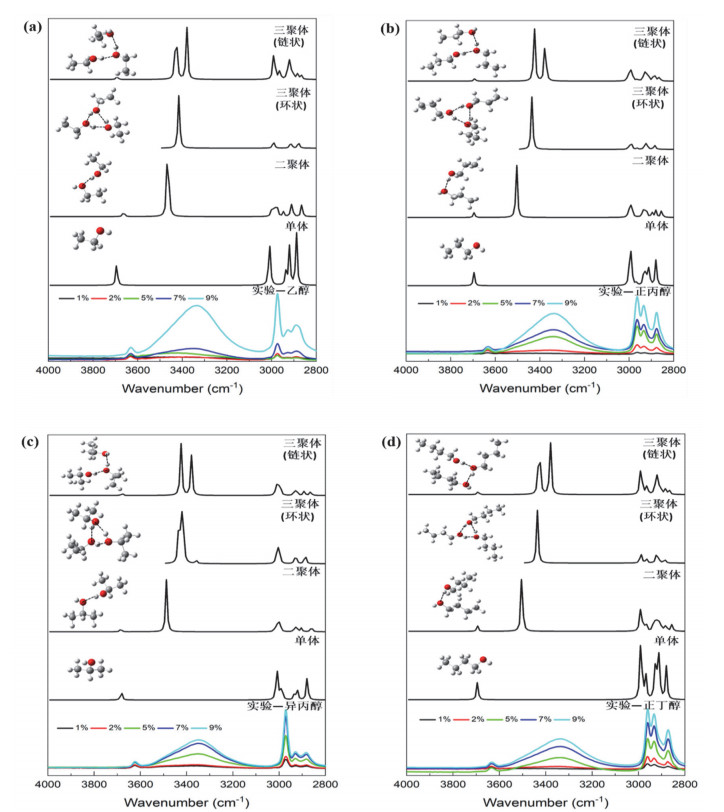
| 乙醇 | 3694.05 | 3483.45 | 3681.97 | 3371.02 | 3379.60 | 3689.36 | |||
| 3432.15 | 3427.58 | ||||||||
| 3435.36 | |||||||||
| 正丙醇 | 3695.95 | 3504.85 | 3695.36 | 3373.36 | 3376.25 | 3691.71 | |||
| 3434.92 | 3425.34 | ||||||||
| 3436.91 | |||||||||
| 异丙醇 | 3682.54 | 3487.77 | 3684.65 | 3358.66 | 3379.46 | 3678.86 | |||
| 3417.03 | 3424.85 | ||||||||
| 3432.37 | |||||||||
| 正丁醇 | 3694.99 | 3503.32 | 3694.27 | 3374.23 | 3380.12 | 3691.13 | |||
| 3436.22 | 3428.25 | ||||||||
| 3436.83 | |||||||||
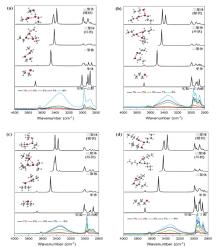
"
| 1 |
Zhang J. ; Chen P. C. ; Yuan B. K. ; Ji W. ; Cheng Z. H. ; Qiu X. H. Science 2013, 342, 611.
doi: 10.1126/science.1242603 |
| 2 |
Kawai S. ; Nishiuchi T. ; Kodama T. ; Spijker P. ; Pawlak R. ; Meier T. ; Tracey J. ; Kubo T. ; Meyer E. ; Foster A. S. Sci. Adv. 2017, 3, e1603258.
doi: 10.1126/sciadv.1603258 |
| 3 |
Li G. ; Zhang Y. Y. ; Li Q. M. ; Wang C. ; Yu Y. ; Zhang B. B. ; Hu H. S. ; Zhang W. Q. ; Dai D. X. ; Wu G. R. ; et al Nat. Commun. 2020, 11, 5449.
doi: 10.1038/s41467-020-19226-6 |
| 4 |
Dereka B. ; Yu Q. ; Lewis ; Nicholas H. C. ; Carpenter W. B. ; Bowman J. M. ; Tokmakoff A. Science 2021, 371, 160.
doi: 10.1126/science.abe1951 |
| 5 |
Sweetman A. M. ; Jarvis S. P. ; Sang H. Q. ; Lekkas I. ; Rahe P. ; Wang Y. ; Wang J. B. ; Champness N. R. ; Kantorovich L. ; Moriarty P. Nat. Commun. 2014, 5, 3931.
doi: 10.1038/ncomms4931 |
| 6 |
Chibani S. ; Badawi M. ; Loiseau T. ; Volkringer C. ; Cantrel L. ; Paul J. F. Phys. Chem. Chem. Phys. 2018, 20, 16770.
doi: 10.1039/C8CP01950A |
| 7 |
Hao M. H. J. Chem. Theory Comput. 2006, 2, 863.
doi: 10.1021/ct0600262 |
| 8 |
George W. O. ; Has T. ; Hossain M. F. ; Jones B. F. ; Lewis R. J. Chem. Soc., Faraday Trans. 1998, 94, 2701.
doi: 10.1039/a803929a |
| 9 |
Coussan S. ; Roubin P. ; Perchard J. P. J. Phys. Chem. A 2004, 108, 7331.
doi: 10.1021/jp048303t |
| 10 |
Fedor A. M. ; Toda M. J. J. Chem. Educ. 2014, 91, 2191.
doi: 10.1021/ed500563w |
| 11 |
Bec K. B. ; Futami Y. ; Woxjcik M. J. ; Ozaki Y. Phys. Chem. Chem. Phys. 2016, 18, 13666.
doi: 10.1039/C6CP00924G |
| 12 |
Jadhav D. L. ; Karthick N. K. ; Kannan P. P. ; Shanmugam R. ; Elangovan A. ; Arivazhagan G. J. Mol. Struct. 2017, 1130, 497.
doi: 10.1016/j.molstruc.2016.10.055 |
| 13 |
Kannan P. P. ; Karthick N. K. ; Arivazhagan G. Spectrochim. Acta A 2020, 229, 117892.
doi: 10.1016/j.saa.2019.117892 |
| 14 | 孙宁杰. 天然产物中密度泛函算法的运用及其振动光谱的研究[硕士学位论文]. 武汉: 武汉工程大学, 2018. |
| 15 |
Tirado-Rives J. ; Jorgensen W. L. J. Chem. Theory. Comput. 2008, 4 (2), 297.
doi: 10.1021/ct700248k |
| 16 |
Emamian S. ; Lu T. ; Kruse H. ; Emamian H. J. Comput. Chem. 2019, 40 (32), 2868.
doi: 10.1002/jcc.26068 |
| 17 | Frisch, M. J.; Trucks, G. W.; Schlegel, H. B.; Scuseria, G. E.; Robb, M. A.; Cheeseman, J. R.; Scalmani, G.; Barone, V.; Mennucci, B.; Petersson, G. A.; et al. Gaussian 16, Revision C. 01; Gaussian, Inc. : Wallingford, CT, USA, 2019. |
| 18 | 中国科学技术大学化学与材料科学学院实验中心. 仪器分析实验, 合肥: 中国科学技术大学出版社, 2011. |
| 19 | 北京大学化学系仪器分析教学组. 仪器分析教程, 北京: 北京大学出版社, 1997. |
| 20 | 徐光宪; 黎乐民; 王德民. 量子化学: 基本原理和从头计算法(上册), 第2版 北京: 科学出版社, 2007. |
| 21 | Joseph W. O. Vibrational Analysis in Gaussian. [2022-05-06]. https://gaussian.com/vib/ |
| 22 |
Merrick J. P. ; Moran D. ; Radom L. J. Phys. Chem. A 2007, 111 (45), 11683.
doi: 10.1021/jp073974n |
| 23 | 吴瑾光. 近代傅里叶变换红外光谱技术及应用, 北京: 科学技术文献出版社, 1994, 597 |
| 24 | Malloum A. ; Fifen J. J. ; Conradie J. Int. J. Quantum. Chem. 2020, 120 (13), e26234. |
| 25 |
Golub P. ; Doroshenko I. ; Pogorelov V. Phys. Lett. A 2014, 378, 1937.
doi: 10.1016/j.physleta.2014.04.032 |
| 26 |
Golub P. ; Pogorelov V. ; Doroshenko I. J. Mol. Liq. 2012, 169, 80.
doi: 10.1016/j.molliq.2012.02.016 |
| [1] | Xuefei Zhao, Xuhong Hu, Zhenhua Jia. Application of Theoretical and Computational Chemistry in Teaching of Friedel-Crafts Alkylation [J]. University Chemistry, 2025, 40(8): 360-367. |
| [2] | Aili Feng, Xin Lu, Peng Liu, Dongju Zhang. Computational Chemistry Study of Acid-Catalyzed Esterification Reactions between Carboxylic Acids and Alcohols [J]. University Chemistry, 2025, 40(3): 92-99. |
| [3] | Supin Zhao, Jing Xie. Understanding the Vibrational Stark Effect of Water Molecules Using Quantum Chemistry Calculations [J]. University Chemistry, 2025, 40(3): 178-185. |
| [4] | Huiying Xu, Minghui Liang, Zhi Zhou, Hui Gao, Wei Yi. Application of Quantum Chemistry Computation and Visual Analysis in Teaching of Weak Interactions [J]. University Chemistry, 2025, 40(3): 199-205. |
| [5] | Xueli Mu, Lingli Han, Tao Liu. Quantum Chemical Calculation Study on the E2 Elimination Reaction of Halohydrocarbon: Designing a Computational Chemistry Experiment [J]. University Chemistry, 2025, 40(3): 68-75. |
| [6] | Jingjing Nie, Wenjun Fang. To Deepen the Understanding of Ionic Crystals in General Chemistry Education [J]. University Chemistry, 2025, 40(1): 362-368. |
| [7] | Xiyao Zhang, Dong Yang, Jie Zhao. The Ubiquitous Noncovalent Interactions: Weak Interactions Unleashing Great Energy [J]. University Chemistry, 2025, 40(1): 277-281. |
| [8] | Jianfeng Yan, Yating Xiao, Xin Zuo, Caixia Lin, Yaofeng Yuan. Comprehensive Chemistry Experimental Design of Ferrocenylphenyl Derivatives [J]. University Chemistry, 2024, 39(4): 329-337. |
| [9] | Dong Xie, Xiaocheng Tian, Xia Zhou, Hong Gao, Li Wu, Li Zhang, Panpan Zhou. Determining the Room-Temperature Conformation of Glycerol Molecules Using Infrared and Raman Spectroscopy Combined with Quantum Mechanical Calculations [J]. University Chemistry, 2024, 39(12): 302-309. |
| [10] | Wenji Guo, Yanqing Zeng, Zijin Lao, Mingtao Wu, Dandan Gao, Qiulian Li, Shiqiong Gong, Fan Luo, Yuefa Gong, Long Wang. Exploring the Charm of Hydrogen Bonding: Synthesis and Properties of Sulfonamide AIE Molecule [J]. University Chemistry, 2024, 39(12): 284-291. |
| [11] | Zhenming Xu, Qingsheng Liu, Jiangan Chen. Application of Materials Studio Software in the Course Teaching of Computational Chemistry and Computational Materials Science [J]. University Chemistry, 2024, 39(1): 332-339. |
| [12] | Ronghao Zhao, Zhiqian Huang, Yiying Yang, Rongxiu Zhu, Dongju Zhang. Application of Theoretical and Computational Chemistry in General Chemistry Curriculum: Ring-opening Reactions of 1,2-Epoxides [J]. University Chemistry, 2023, 38(8): 299-304. |
| [13] | Yanchun Guo, Huiting Wang, Donghui Wei, Xiaolan Chen, Shuxia Cao. Brief Discussion of the Influence of Ring Strain on Infrared Absorption Frequencies of C=C and C=O Double Bonds [J]. University Chemistry, 2023, 38(8): 305-311. |
| [14] | Sainan Liu, Zhaoxia Wang, Shouhong Xu. Trehalose with Reviving Function [J]. University Chemistry, 2023, 38(7): 194-198. |
| [15] | Jian Jin, Xueping Yang, Jing Cheng, Peng Ren. Exploratory Organic Chemistry Experiment Based on Hydrogen Bond Induction Theory: Synthesis and Rapid Identification of (+/−)-2-Methylenecitronellal [J]. University Chemistry, 2023, 38(1): 220-226. |
|
||
